
Reclaiming Their Names: Survival, Grace, and the Untold Truths of the Klondike Gold Rush

Some excursions from vacation cruises entertain you.
Some stay with you long after you leave, echoing in the quiet spaces of your mind.
The Ghosts & Goodtime Girls Walking Tour in Skagway, Alaska, was one of those experiences for me.

As we walked through the cold, rain-slicked back alleys past the historic, weathered brothels of the Klondike Gold Rush, I couldn't stop thinking about the women who once inhabited them. In popular folklore, their lives are so often reduced to lighthearted legends, spooky ghost stories, or bawdy caricatures. But as an author and advocate who spends her life looking into the eyes of trauma and survival, I didn't see ghosts. I saw real, breathing women who were forced to navigate a highly extractive and unregulated world.
Our guide, Madame Georgia Peach, shared a haunting detail: every night, many of these women changed both their names and their rooms. In the colorful stories told to most tourists, this is framed as a game of mystery and excitement. But our guide told us the historical truth, which is far heavier. It was a calculated, desperate strategy for physical survival, a way to disrupt the tracking patterns of abusive clients, avoid stalkers, and find a shred of safety in a lawless frontier that viewed them as entirely disposable.

To understand their lives, we have to look at the brutal economic reality of the Gold Rush. For an unmarried, widowed, or abandoned woman, standard labor like laundry or waitressing paid a meager $0.75 to $3.00 a day, wages that made it mathematically impossible to survive in a hyper-inflated frontier economy. Worse, the local authorities didn't seek to protect these women; instead, they institutionalized and regulated vice, charging the women quarterly "fines" of $25. The system essentially funded municipal operations by taxing the bodies of its most vulnerable citizens. With no other options, many became "women of the night" not by choice, but because the alternative was literal starvation.

Walk into Skagway's famous Red Onion Saloon, which operated as a grand brothel back in 1898, and you'll see just how transactional and systematized this life truly was. Upstairs sat ten tiny "cribs,” 10x10 rooms where the girls lived and worked. To run this operation like a well-oiled machine, the saloon used a highly unique signal system: ten dolls sat behind the bar downstairs, each crafted to look like one of the ten women upstairs. A miner looking for company would choose his girl by her doll and drop money in a hole in the floor for discretion. The bartender would then lay that doll flat on her back, or sideways, signaling to everyone in the room that she was "busy" and unavailable. Only when the client returned downstairs would the doll be sat upright again. It was a visual menu of human bodies, stripped of intimacy and reduced to a wooden token.

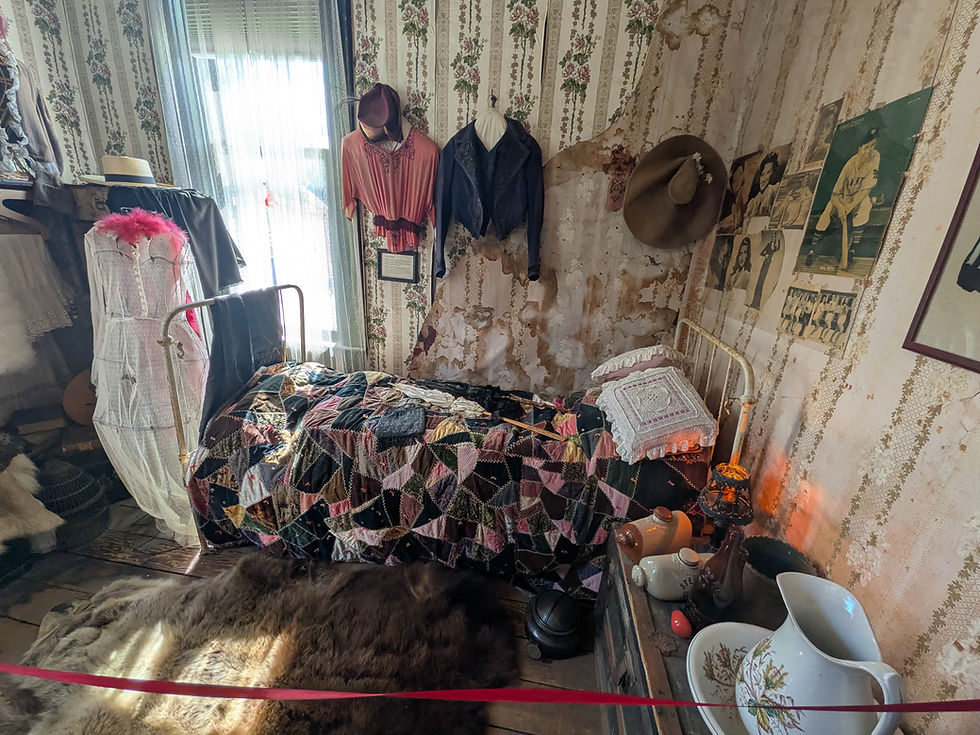
Yet, even in a system designed to treat them as mere commodities, these women fought to claim whatever tiny fragments of dignity and humanity they could. Inside those cramped 10x10 cribs, they would pick out and hang their own wallpaper. In a world where they owned almost nothing, choosing their own wallpaper was one of the very few areas where they had total autonomy. It allowed them to put their own likes, their own memories of home, and a piece of their true selves into their living situation. It was a quiet, beautiful act of resistance, a statement that they were more than the transactional walls they were trapped within.

But the economic starvation was only the beginning; the physical reality of working on "the Line" was a gauntlet of bodily terror. Contraception was crude, expensive, and incredibly difficult to come by. Many went to the black market. In that era, the primary barrier options were thick, vulcanized rubber condoms, or made from animal parts. They were designed to be washed and reused, but these women were never educated to know that after just two uses, they became horribly ineffective.
On the frontier, becoming pregnant was the ultimate death knell. If a woman became pregnant and chose to keep her baby, she was instantly cast out. She would lose her housing, her protection, and the three basic meals a day provided by the brothel. Desperate and terrified of being left to freeze or starve, many turned to unspeakable back-alley routes. They used clothing hangers, or, to my absolute horror, they used Lysol. Yes, the very same Lysol disinfectant we use to clean our homes today was aggressively marketed back then as a "feminine hygiene" douche. The caustic formula, which at the time contained highly toxic cresol, was introduced directly into their bodies. It did not prevent pregnancy, but it did cause agonizing internal chemical burns, leaving countless women mutilated, sterile, or dead.

And then there was the rampant specter of syphilis. On the frontier, sexually transmitted diseases were treated as a moral failing of the woman alone. If a woman was found to have contracted the infection, she faced a punishment of unimaginable cruelty: she was branded with a line directly across her face with a hot iron, permanently marking her to the entire world as "tainted". Yet, the men who frequented the brothels and spread the virus were never checked. This branding made these women completely untouchable, isolated, and unemployable, essentially booking them a direct, agonizing route to death.
It was a world of transaction, but amidst the darkness, there were breathtaking acts of grace.
One story I will never forget is that of Mollie Walsh.
The local legends often paint a simplified picture of Mollie asking a priest for last rites for a dying working girl. But the real history is so much more profound. When Mollie discovered that a childhood friend from high school in Minneapolis was working in a local brothel and dying of a terminal illness, she defied the intense social stigma and sat by her bedside, nursing her personally.

Mollie didn't look for a priest; she brought her pastor, Reverend R.M. Dickey, to the dying woman's bedside to read scripture and offer comfort. When her friend passed away, Mollie insisted that her funeral be held inside the town's newly built Union Church.
It was an act that scandalized "respectable" society. The elite members of the congregation sat aloof, openly showing their disapproval. Yet, in a beautiful display of solidarity, fifty sex workers filled the church, kneeling in the aisles in tears. That single service was so powerful that Captain Samuel O'Brien of the steamship SS Shamrock, who was in attendance, was moved to offer free passage to Seattle to any woman wishing to escape "the life". Backed by emergency funds raised by Mollie, fifty women boarded that ship that very night to start anew. Mollie didn't just offer comfort; she helped spark a structural rescue.
Then there was Harriet "Ma" Pullen.
The tour guides will tell you she arrived in Skagway with only three dollars, but historical records show she actually arrived with seven dollars to her name, having left her four children in Washington state while she paved a way to support them. She cooked for William Moore's pier crew by day, and by night, she hammered discarded tin cans into pie plates, baking apple pies that sold for $10 each to hungry prospectors.
She used her pie profits to import her horses and run a highly successful freighting business on the hazardous White Pass Trail, eventually converting Captain Moore's mansion into the luxurious Pullen House Hotel.
But Harriet's true legacy isn't just her business brilliance. It is what she did with her hard-won influence. When the Alaska Territory passed its women's suffrage bill on March 21, 1913, Harriet mobilized. She adorned her horse-drawn "Pullen House Bus" with signs reading “Vote Dry and Protect Your Home,” and used it to personally transport women, including the heavily marginalized women of the brothels, directly to the polling locations. Harriet understood a fundamental truth: every woman, regardless of her social standing, deserved political franchise and legal protection as a shield against exploitation.
But the part of the tour that broke my heart most wasn't about the women.
It was the children.
Historical records show that children as young as 10 years old were stolen, bought, and trafficked into prostitution during the Gold Rush, heavily targeting Tlingit Native girls and Asian minors trafficked through Pacific ports.
I desperately searched the historical archives, hoping to find the name of the youngest documented girl brought into this life, to write it down, to give her back a piece of her stolen humanity.
But history is brutally silent here.
There is a tragic, systemic reason we don't have her name. The frontier vice machine was engineered to erase these children. The moment a child was brought into a brothel, traffickers stripped them of their legal identities, forcing them to use generic "working names" or colorful aliases to prevent their families from ever tracking them down. Madams forced minors to sign falsified age affidavits, and local courts and police, who profited heavily from the taxes on vice, practiced a deliberate "tacit ignorance". They routinely processed arrested children as adult prostitutes rather than victims of horrific abuse, collecting their fines and sweeping their names into the shadows.
As the author of Because of Jane and an advocate for survivors of child abuse and domestic violence, those stories are impossible to hear without feeling the crushing weight of them.
When I look at those lost names, I think of Jane, the stitched doll from my memoir who stood as a silent witness and protector through the darkest rooms of my own childhood trauma. As children, when we are trapped in environments where love and fear live side by side, we learn to survive using the only tools we have. We dissociate. We create fantasy worlds, we sing songs, we build imaginary futures just to escape the physical reality of the rooms we are locked in.
In modern trauma-informed spaces, we now recognize that survival behaviors, whether it’s hyper-vigilance, over-explaining, people-pleasing, or the desperate "maybe now" hope of performing perfectly to finally be safe, are not weaknesses. They are signs of profound intelligence and self-protection.
The women and children of the Klondike who changed their names, who rotated their rooms, and who did whatever they had to do to survive, were not merely "bawdy" or "disreputable" historical caricatures. They were master survivors.
The faces of exploitation may have changed over the last century, but the dark undercurrents have not. Even today, in modern Alaska, federal cases like United States v. Webster document children as young as 13 being trafficked under the guise of escort services. Studies show that up to 28% of homeless and at-risk youth in the region have experienced sex trafficking, with Indigenous youth continuing to be disproportionately targeted due to intergenerational trauma and systemic neglect.
The fight to protect children and end human trafficking is not a relic of 1898. It is a battle we are still fighting today. Look at the high profile international sex trafficking Epstein Files.
History isn't just about gold.
It's about the women who fought to survive.
It's about women like Mollie Walsh, who chose radical, boundary-breaking compassion over societal judgment.
It's about women like Harriet Pullen, who refused to believe that some women deserved fewer rights than others and used her own bus to carry them toward their voice.
And it is about the countless women and children whose real names have been lost to the archives, but whose spirits still demand to be remembered, honored, and protected.
A heartfelt thank you to Madame Georgia Peach, whose passion and storytelling brought these women back to life. This wasn't just a ghost tour. It was a sacred opportunity to pull these voices out of the historical silence and honor those who history too easily chose to ignore.
If you ever visit Skagway, I cannot recommend the Ghosts & Goodtime Girls Walking Tour enough. It is powerful, heartbreaking, inspiring, and one of the most meaningful excursions I've ever experienced.
References
Alaska Children's Trust & Covenant House Alaska. "Unraveling the Stories of Sex Trafficking in Alaska." Anchorage, AK.
**Brackbill, Eleanor. The Queen of Heartbreak Trail: The Life and Times of Harriet Smith Pullen, Pioneering Woman. Washington, DC: Rowman & Littlefield, 2016.
Brown, Shannon. Because of Jane. Massachusetts : Self-Published, 2025.
Dickey, Rev. R. M. Gold Fever: A Narrative of The Great Klondike Gold Rush, 1897-1899. Toronto, ON: Union Church Archives.
Morgan, Lael. Good Time Girls of the Alaska-Yukon Gold Rush: A Secret History of the Far North. Fairbanks, AK: Epicenter Press, 1998.
Spongberg, Mary. Feminizing Venereal Disease: The Body of the Prostitute in Nineteenth-Century Medical Discourse. New York, NY: New York University Press, 1997.
Tone, Andrea. Devices and Desires: A History of Contraceptives in America. New York, NY: Hill and Wang, 2001.
United States v. Webster, Case No. 08-30311 (D. Alaska 2008).
Yukon Status of Women Council. "Research on Sex Work & Human Trafficking in the Yukon Territory." Whitehorse, YT.
🛡️ Survivor Support & Safety Awareness
Part of healing is also finding ways to feel safe again.
That's why I'm proud to be in collaboration with Hootie Security Alarms. 💜
As a survivor of childhood abuse and domestic violence, personal safety is incredibly important to me.
💜 For every 4 Hooties I sell, 1 is donated to a domestic violence shelter.
Visit gethootie.com and use code JANE for 10% off your order.
Because everyone deserves to feel safe.
💜 Continue the Journey
The Survivors’ Anthem Series is more than a collection of songs, it's a journey through survival, healing, and strength.
📖 Read Because of Jane
💜 Learn about The Jane Project


Comments