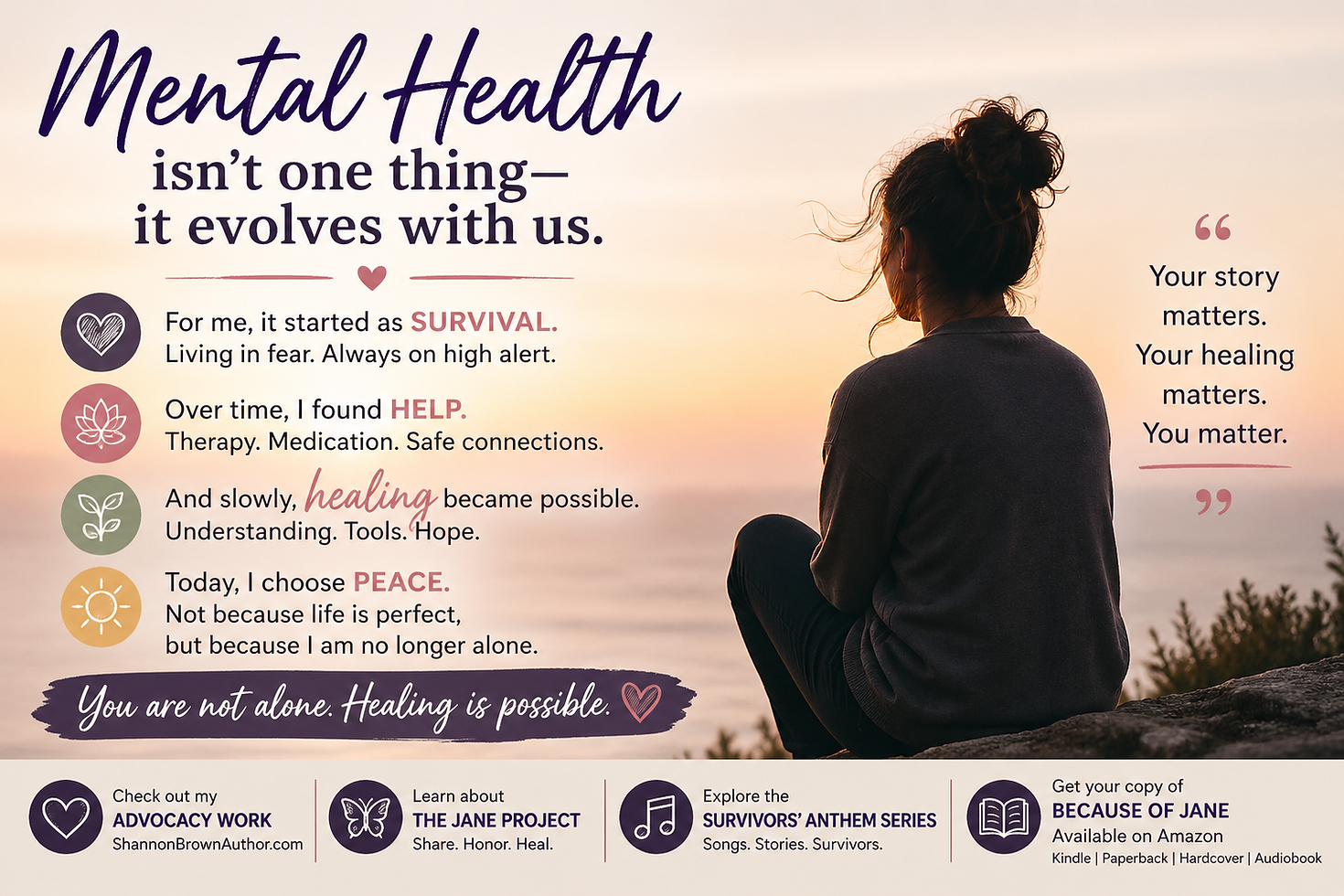
Mental Health Isn’t One Thing - It Evolves With Us

By Shannon Brown
Mental health is something that has evolved with me over time.
When I was younger, I didn’t have the language to name what I was feeling. I didn’t know words like anxiety, trauma, or hypervigilance. I just knew that my body never felt calm. It felt like my veins were constantly pulsing, like something inside me was always on high alert.
As a child, I was living in a home where I witnessed domestic violence. Later, I experienced abuse myself. My nervous system didn’t have the option to relax, it was wired for survival.
Even in moments where life looked “normal” from the outside, family vacations, opportunities to just be a kid, and though I do cherish the memories, bsomething had already shifted inside me. I had lost my sense of safety early. I grew up too fast.
So in my younger years, my mental health didn’t look like what people often picture.
It looked like survival.
When Survival Follows You
Trauma doesn’t just stay in the past, it travels with you.
When I went to college, I thought I was stepping into a new chapter. But instead, my mental health showed up in a different way: insomnia.
During my first semester, I barely slept. Even with the health center prescribing me. Ambien (surprising? My aunt was so mad) to sleep, my mind was stronger and I still didn't sleep. So, every weekend, I would go home just to get one full night of rest. Then I’d return to campus and the cycle would start again.
Looking back now, I understand why.
For the first time, I was completely on my own, far away from home, from familiarity, from anything that felt safe. And there was a fear I couldn’t shake:
What if he finds me here?
What if something happens and no one knows?
That kind of fear isn’t irrational when it’s rooted in lived experience. It’s what trauma experts describe as a persistent sense of threat, where the brain and body continue to operate as if danger is still present, even when it isn’t.
On top of that, I hadn’t made friends yet. Trust didn’t come easily to me. When you’ve been hurt, your brain learns to protect you by keeping people at a distance.
But then something shifted.
I made a friend, someone who became one of my closest friends to this day. And that connection changed everything. I started to feel safer. I started to sleep. I started to breathe a little easier.
That’s something we don’t talk about enough:
Safe relationships can be incredibly healing.
Understanding Trauma and Mental Health
What I was experiencing has a name.
Many survivors of abuse experience symptoms related to trauma, including:
Hypervigilance (always feeling on edge or alert)
Insomnia or disrupted sleep
Anxiety or panic responses
Difficulty trusting others
Intrusive thoughts or fears
These responses are not “overreactions.” They are adaptations, ways the brain and body learned to survive.
The brain’s threat detection system (often called the fight, flight, freeze, or fawn response) becomes overactive after trauma. It’s not a flaw, it’s a survival mechanism that just hasn’t learned yet that it’s safe to stand down.
Choosing to Heal
As I got older, I began to seek help. Therapy changed everything for me.
Having a space where I could talk openly, without judgment, was freeing. For so long, everything I had been through was held inside my body and mind. Speaking it out loud helped release some of that weight.
Therapy isn’t just about talking, it’s also about learning.
It gave me tools:
Ways to regulate my emotions
Techniques to calm my nervous system
Strategies to challenge anxious thoughts
Space to process trauma safely
There is something incredibly powerful about having an impartial, trained professional who can help you unpack what you’ve been carrying.
I know there is still stigma around therapy.
It can feel uncomfortable. Vulnerable. Even scary.
But asking for help is not weakness, it’s self-awareness and strength.
Medication and Mental Health
For me, medication was also part of my healing journey. I understand that not everyone feels comfortable with medication, and that’s okay. Mental health care is deeply personal. But for me, starting anxiety medication was life-changing.
For the first time, I experienced what calm actually felt like.
That constant pulsing feeling in my body, the one I had lived with for so long, quieted. It was surreal.
Medications like antidepressants or anti-anxiety medications work by helping regulate brain chemicals such as serotonin, dopamine, and norepinephrine, which play key roles in mood, stress response, and emotional balance.
They are not a “fix-all,” but for many people, they are an important and effective tool, especially when combined with therapy.
Mental Health Is Not One-Size-Fits-All
One of the most important things I’ve learned is this: Mental health is not static. It evolves.
What you need in one season of life may not be what you need in another.
Sometimes it looks like survival
Sometimes it looks like seeking help
Sometimes it looks like medication
Sometimes it looks like connection
Sometimes it looks like simply getting through the day
And all of that is valid.
Breaking the Stigma
There is still so much stigma around mental health, especially when it comes to trauma, therapy, and medication.
But here’s the truth:
You are allowed to need help
You are allowed to talk about your experiences
You are allowed to heal in your own way, on your own timeline
You don’t have to carry everything alone.
If You’re Struggling
If any part of this resonates with you, please know this: You are not broken. Your responses make sense. And healing is possible.
Whether it’s therapy, medication, building safe relationships, or simply learning more about your own mind, there are paths forward.
Final Thoughts
Mental health, for me, started as survival. But over time, it became something more. It became understanding. It became healing. It became finding moments of peace I didn’t know were possible. And if that’s possible for me, it’s possible for you too.
💛 If this spoke to you, feel free to share your thoughts or your journey.
💛 Continue the Conversation. Be Part of the Healing.
If this story resonated with you, you are not alone, and your voice matters.
✨ Explore the advocacy behind the message:
Learn more about the mission to raise awareness, create safe spaces, and support survivors through meaningful work and storytelling.
👉 Visit: ShannonBrownAuthor.com
🌸 Discover ✨ The Jane Project ✨
Not every survivor had a safe person, but many had something that helped them get through.
A song. A toy. A memory. A feeling.
The Jane Project is a space to honor those lifelines, the things that helped us survive.
💜 What was your “Jane”?
💜 Share your story.
💜 Be part of something powerful.
🎶 Experience the Survivors’ Anthem Series
Music has a way of reaching places words alone cannot.
The Survivors’ Anthem Series highlights songs that gave voice to survival, healing, and resilience, paired with real stories and reflections.
💛 Feel the connection and read the blogs on ShannonBrownAuthor.com
✨ Submit your own anthem
📚 Read the Story Behind the Advocacy
Because of Jane is more than a memoir, it’s a story of survival, resilience, and finding your voice after trauma.
Available now on Amazon in:
✔️ Kindle
✔️ Paperback
✔️ Hardcover
✔️ Audiobook
👉 Get your copy today and be part of breaking the silence.
💬 Let’s Keep the Conversation Going
What does mental health look like for you right now?
Share in the comments, reach out, or connect on social media. Every story shared helps break stigma and build understanding.
💙 You are not alone. Healing is possible. And your story matters.


Comments